I just realized I never posted this great summary video of last summer's Wild Rumpus program here on the blog:
This seems like a great opportunity to also remind you that this year's Wild Rumpus begins next week! Each program will run from 5:00-7:30 p.m., starting June 24 and going through August 15. The Let's Eat Out food trucks will be at each event, or you can pack a picnic dinner. Check the library's online calendar for last-minute weather cancellation announcements.
Mondays, Brittingham Park
Wednesdays, Haen Family Park
Thursdays, Reindahl Park
Jun 21, 2019

Apr 24, 2019
Book Look (A Whole Book Approach Storytime): Gutters

This week was our final Book Look Storytime and we were examining gutters. Just in case you don't know already, gutters are the crease at the center of the book, where the binding comes together. All of the books above make interesting and effective use of the gutters. Let me show you a few examples:
In Jon Agee's new book, The wall in the middle of the book, a gutter becomes a brick wall that literally divides one side of the book from the other. There's some question about which side is the "safe" side and in this spread, the ogre manages to reach OVER the wall by escaping the confines of the pages themselves:


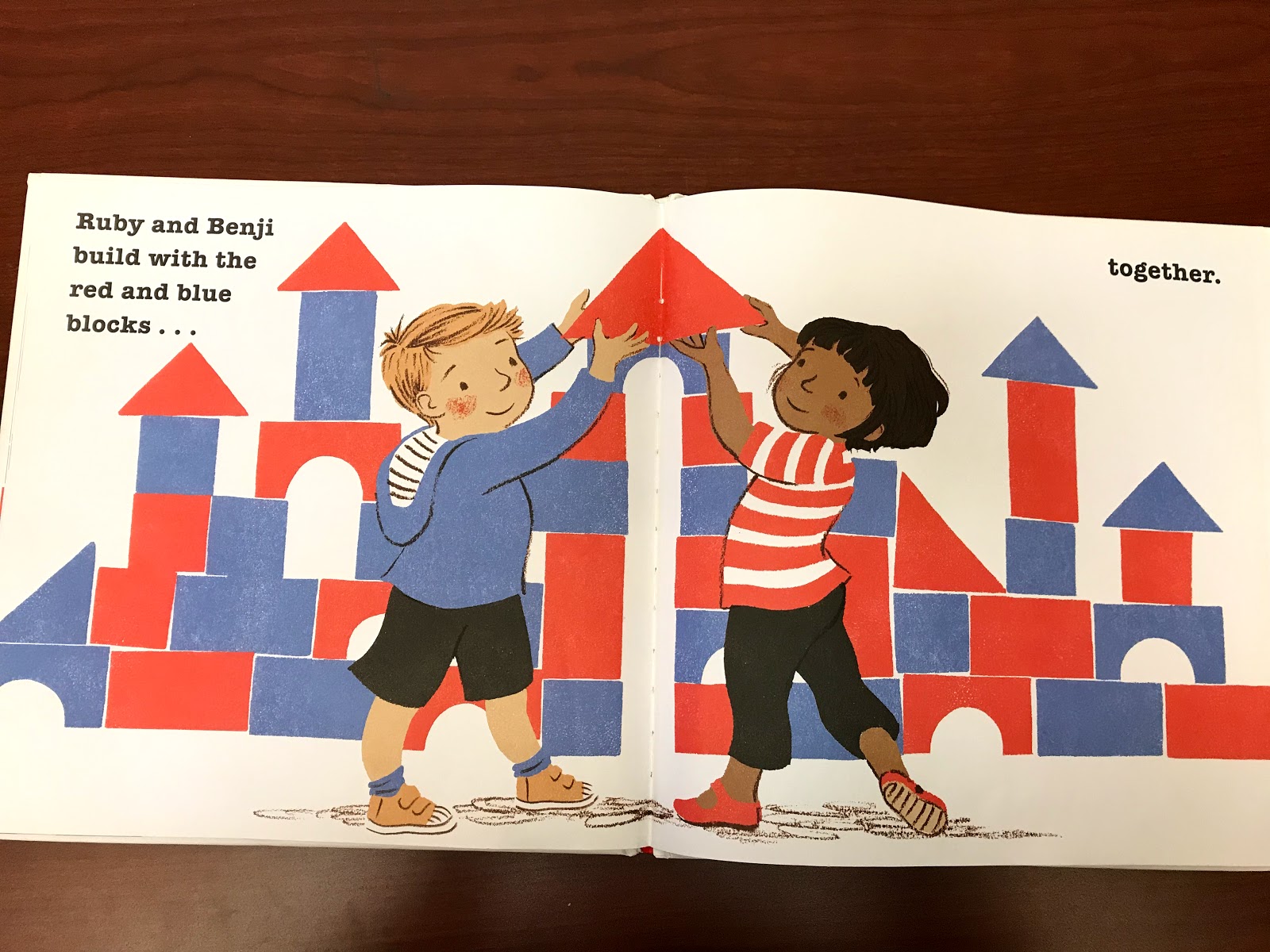
When they reconcile their differences and build something together, the apex of their structure is... right over the gutter!
Two tall telephone poles, (pointer fingers up!)
Between them a wire is strung. (tips of middle fingers touch each other)
Two little birds hopped onto the wire (thumbs are the birds)
And they swung, swung, swung. (swing it back and forth)
We did the app OLO Game because the action in that game is all about crossing the gutter!


All in all, this has been a really interesting series, but not well-suited for the three-and-under crowd. While I will likely still pull in some of these techniques for one or maybe two books during my regular preschool storytime programming, doing an entire storytime based on this approach lost a few of the more active younger kiddos and some of the older kids got impatient and begged me to "just read the story!" But I love asking kids what they notice because it's often a revelation to me and I even loved letting them choose which book I read from a selection of titles standing up on a table. It's as close as I can get to a "self-determined storytime"!
Apr 18, 2019
Book Look: A Whole Book Approach storytime, week 3 (Amazing Endpapers!!)

First, I consulted Lambert's fantastic round-up of book titles with exceptionally interesting endpapers and through that I discovered Ruzzio's This is not a picture book. The difference between the endpapers at the beginning and end of this book is subtle but SO, SOOOO significant!


The kids also noticed how the background of the pages is utterly blank until the duckling begins to read and then... the world becomes full of color and detail. So many great design details here in the illustrations and endpapers--just check it out for yourself!


The first book we actually read together was Sam and Dave Dig a Hole by Jon Klassen and Mac Barnett. I LOVE how the subtle endpapers tie in to the story (hint, check out the trees). The kids loved how the endpapers matched my outfit today!




What are your favorite endpapers?
Apr 17, 2019
Book Look: A Whole Book Approach Storytime (week 2, Orientation + a little Gutter talk)

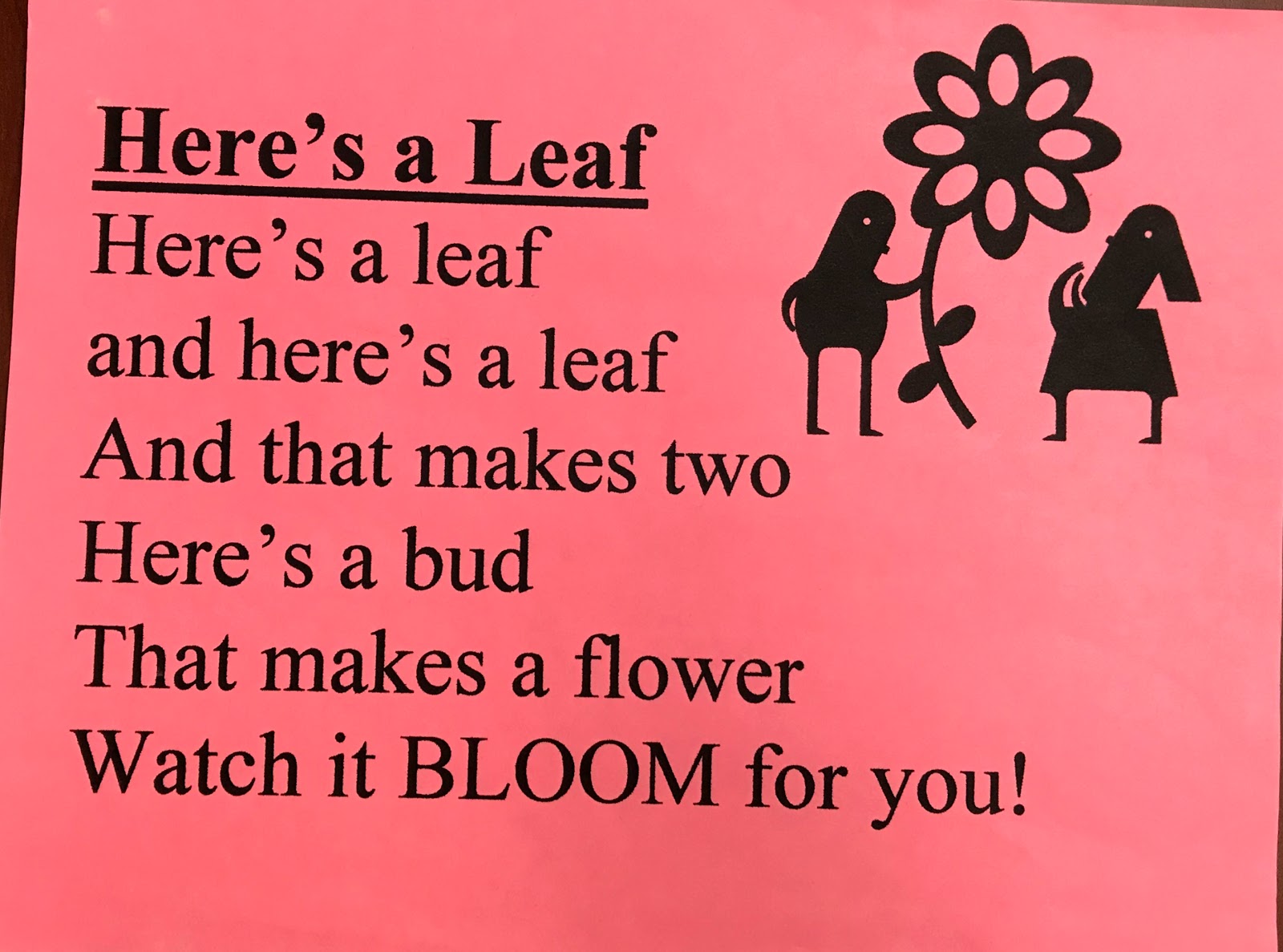
We started off with a little action rhyme:

Then we moved on to reading Building with Dad by Carol Nevius, illustrated by Bill Thompson which has such great perspectives in the illustrations! The spine is on the TOP of the book (I'm sure there's an official binding or book design term for that, but I don't know what it is!) so that when you open the book it appears even TALLER than the cover image. The kids pointed out that although many of the images are from down low, looking up high, there are a few where we are up high, looking down to the ground. We also talked about the shifting horizon line and how it might help dictate how we should hold the book on each page. (sorry, I've already sent my copy of the book along to another storytime, so you'll just have to find your own copy of the book to examine, but it is WORTH it. One of my favorite "construction" books!)
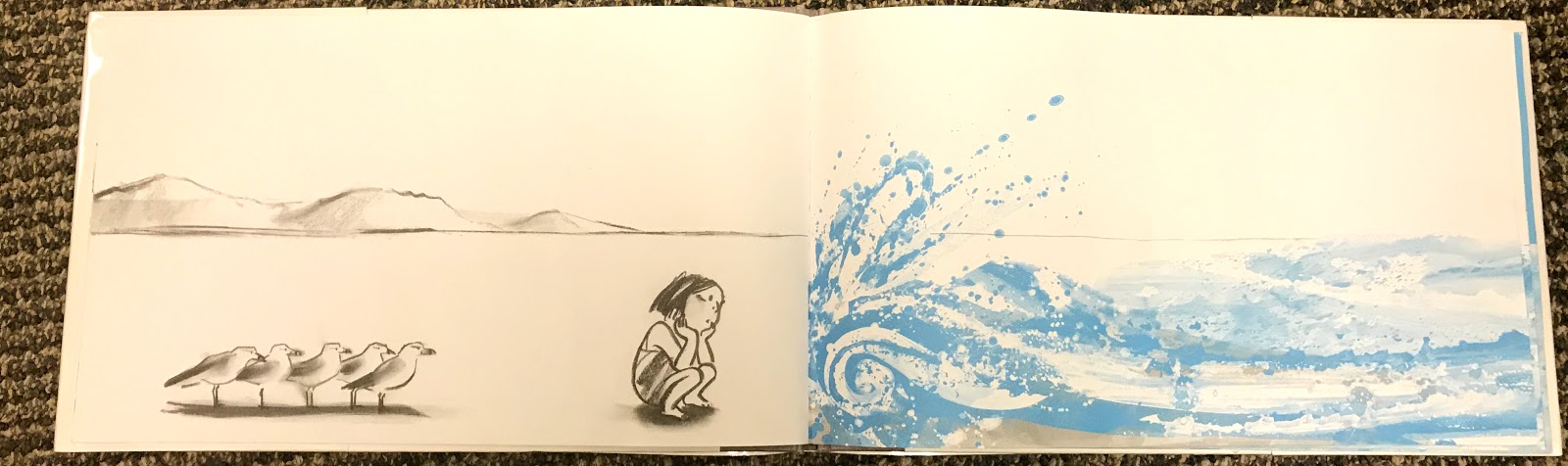
Next, the kids chose to read the book Wave by Suzy Lee. Although the horizontal pull of the wave and the width of the beach make the portait landscape an easy choice, we ended up talking a lot about the gutters in this book! How at first, the gutter clearly divides the water from the girl and the birds:
and a few pages later, the girl and the birds cross over the gutter to join the water:

and then how the mountains fade to nothing because the only thing interesting is playing with water:
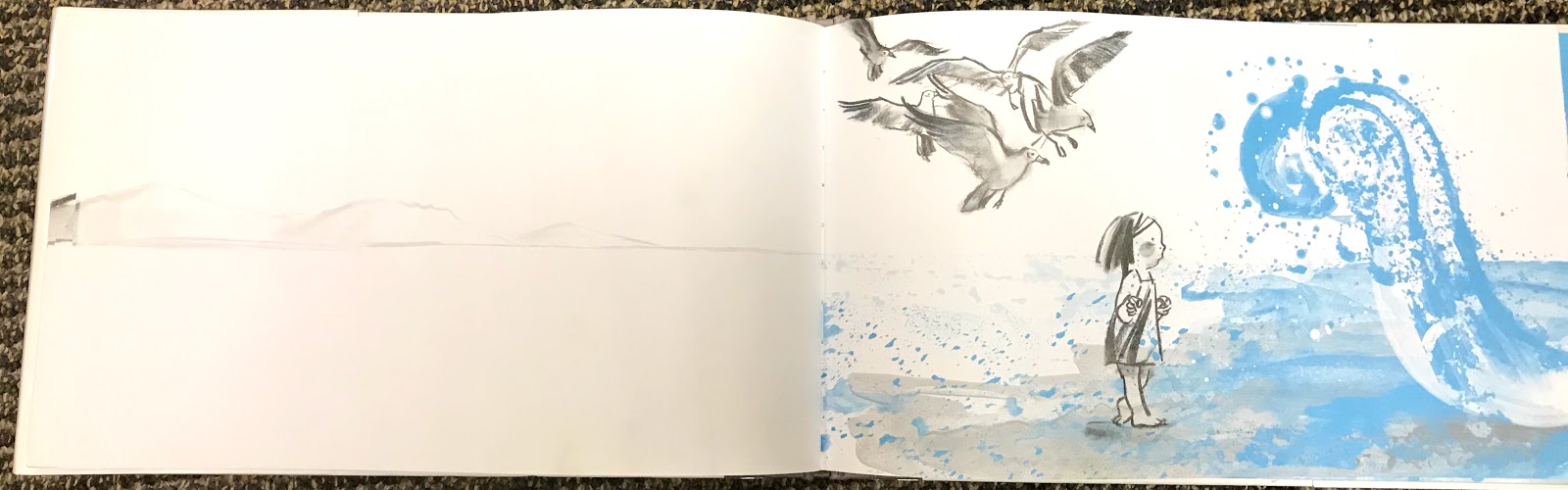
And then when the girl and the birds cross back over the gutter to get away from the water:

And of course, when the water finally crosses the gutter in this magnificent fashion, getting EVERYTHING wet...

I used, "Oh! The Magic Drawing App" as our app of the day because it does a PERFECT job of demonstrating the difference between portrait and landscape, plus it's a book app (a companion app to the book "That's my hat!") and it's free!
At this halfway point, I feel like this storytime would be EXCELLENT for school-age kids, but is stretching the preschoolers pretty far. Most of my responses are from a homeschool family that attends and a few of the parents making keen observations as well. But if you've got a regular program that combines books and school age kids... I think this would be a hit!
Next week we'll be looking at endpapers by special request of one of the kiddos! (I LOVE endpapers...)
Subscribe to:
Posts (Atom)